
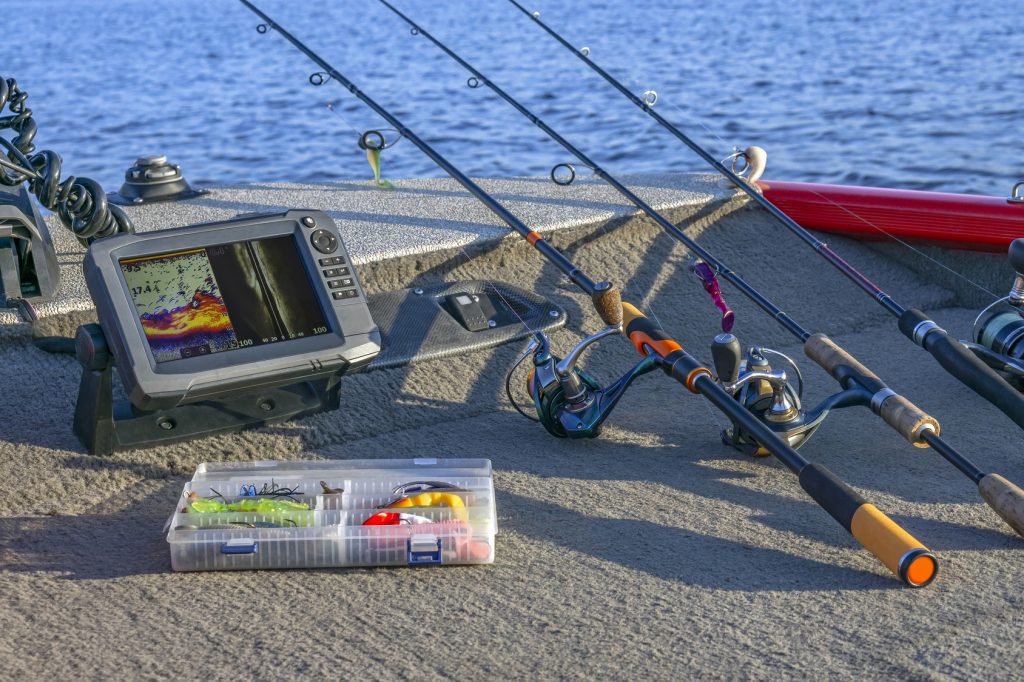
The best fish finders are designed to save you time, frustration and the work that comes with spending several hours on your boat, searching for the perfect place to drop anchor. But not all fish finders are created equal. Some aren’t nearly as accurate as the manufacturers claim they are, while others are difficult to use in certain water and weather conditions. This is where I come in. I’ve done all the hard work for you, researching several of the best-selling models on the market. I’ve narrowed it down to the top five fish finders, each of which has something special to offer, whether it’s the best GPS package, or the perfect model for kayak use.
Below you’ll find a comparison chart which lists some of the similarities and differences between each of the models, in addition to summaries for each of the devices that made it onto my top five list.
Table of Contents
Fish Finders Comparison Chart
| Product | Transducer | Depth | Cost | Rating |
|---|---|---|---|---|
Humminbird HELIX 7 | Dual | 125 ft | $$$$ | |
Garmin Striker 4 | Dual | 600ft freshwater 750ft saltwater | $ | |
Lowrance HOOK2 | Triple | 300-side and down scan 500ft CHIRP | $$$$$ | |
Garmin EchoMAP | Single | 800ft | $$ | |
Raymarine Axiom 7 | Single | 900ft | $$$$$$ |
Best Choice for Small Boats-Humminbird HELIX 7 G3 Fish Finder

Our Rating:
The Helix 7 is Humminbird’s leading model thanks to its intuitive controls, lightweight design, 360 imaging, and the powerful transducer. Unlike many of the competing models, the 7 is Bluetooth compatible, so you can pair your device with your smartphone and take advantage of the Fish Smart app or update the device remotely, with just the touch of a button. Feature-packed and beginner-friendly, the Helix 7 has a lot to offer anglers of all skills levels.
Top Fish Finder GPS Combo-Garmin Striker 4 Fish Finder

Our Rating:
The Striker 4 by Garmin comes with a high waterproof rating, which makes it suitable for both saltwater and freshwater angling, and a lightweight, compact design that makes it highly portable. This model isn’t quite as feature-packed as some of Garmin’s other higher priced models, but it does come loaded with some great features that can make it easier to locate fish, save important data regarding hot spot locations, and a powerful transducer that helps to significantly improve image quality.
Best Choice for Kayaks-Lowrance HOOK2 7 Fish Finder

Our Rating:
The Hook2 features a large color display screen, a three in one transducer with CHIRP sonar and side scan and down scan imaging. This device also gives you the ability to save important waypoints, so you’ll be able to make your way back to a hot fishing spot the next time you’re out on the water. The fact that it comes loaded with a variety of map plotting features it just one of the reasons this model keeps flying off the shelves. Easy to use and highly accurate, the Hook2 7 is one fish finder you won’t ever want to find yourself on the water without.
For Pontoon Boats-Garmin EchoMAP Fish Finder

Our Rating:
The Echomap by Garmin comes with the patented SideVu and DownVu imaging, a large seven-inch color display, and CHIRP sonar for a more accurate and easier fish-finding experience. Additionally, this device comes with over seventeen thousand maps of lakes all over the US. It also comes with the free Quickdraw software program which allows you to create your own detailed maps, so you can capture each and every important detail. Aside from maps, the fish finder’s highly accurate ClearVu sonar will give you every reason to buy.
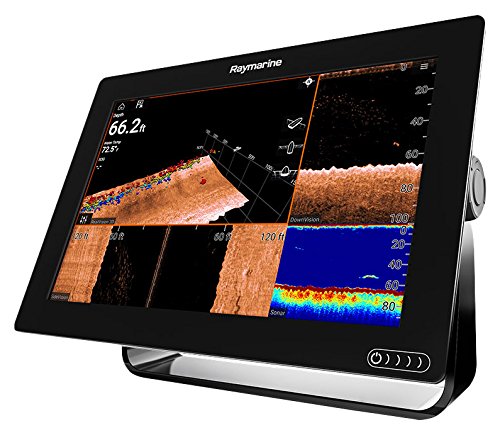
Leading Model with Side View-Raymarine Axiom 7 Fish Finder
Our Rating:
The Axiom 7 by Raymarine is easily one of the most feature-packed fish finders on the market. The fact that it’s also Wi-Fi compatible comes as no real surprise. Buyers can download the Raymarine app and use it to control the settings, or they can take a look at the Navionics charts and have instant access to thousands of maps of lakes for both Canada and the US. This is a device that’s perfect for the serious angler in need of a fish finder that’s durable, highly accurate, and perfect for use in uncharted waters.
Buyer’s Guide
A fish finder will allow an angler to see the fish, objects, and structures beneath the boat, in great detail. This makes it much easier to spot fish and determine if a particular area is a good option to drop anchor or if they need to move on and continue looking for a better fishing spot. When you’re shopping for the best fish finder, consider what type of model you want and need, whether you want it to include GPS, high resolution, and how much power you need. Where you fish, such as calm waters or ocean angling, can also have an impact on what type of model will be right for you.
Feature-Packed
There are a few options to choose from when you’re trying to find the right model. Do you want a fish finder that’s equipped with GPS navigation? A model that has chartplotting features? Or do you just need a basic fish finder that will not perform any other functions?
Standalone models allow you to view what’s going on under the boat, but they don’t come with any special extra features. However, they’re a great option if you’re on a tight budget, or if you have a smaller fishing boat and only need one of these devices to fish small lakes and rivers.
Split Screen Mode
A model with chartplotting abilities will be a great buy for mid-sized fishing rigs. You can take advantage of the GPS for navigation, and simultaneously view charts and the structures and fish activity going on under the boat using the device’s split-screen feature. Or you can switch it to the basic fish finding mode.
GPS
GPS relies on satellites in order to pinpoint your exact location when you’re out on the water. This feature will allow you to mark any fishing hot spots, and can help you to find your way back to your starting point, quickly, in the event of an emergency. You can also map out coordinates for your favorite fishing spots, using map software.
Most fish finders with this feature are combo units. This means they have a chartplotter and a depth sounder. The chartplotter feature will display your location superimposed over the map, which will tell you exactly where you are at all times. Logging waypoints is simple and an important feature that will allow you to take note of launch ramps, structures, and fish. Once you’ve saved a waypoint, you can access this information any time. If you’ve ever had trouble remembering where the fish were biting on your last trip or dangerous areas you want to avoid at all costs the next time around, then this feature will be invaluable.
Wi-Fi
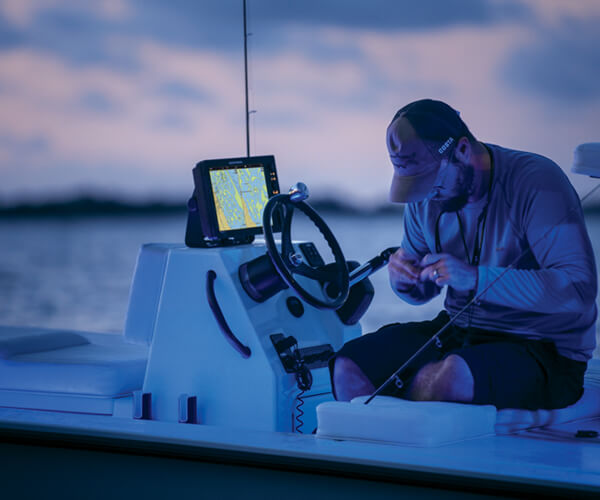
There are also fully networked models that are designed to support a wide range of data sources including radar, satellite radio, and more. Many are also Wi-Fi and/or Bluetooth compatible, so they can be paired with your smartphone. This will allow you to use your phone to update your fish-finder remotely, adjust the settings, or even access some of the charts all with just the touch of a button.
Display Size and Quality
Displays with more vertical pixels will have better depth resolution since each of the pixels represents less depth. The pixel count in a display’s horizontal axis is what will determine the amount of time an object will remain onscreen before it scrolls out of view. A split-screen display will show very narrow columns with side by side viewing.
A display that features more pixels per square inch can better represent what’s below the surface of the water, offering more detail of structures. They will also provide improved split-screen viewing. If the device has a bigger display and higher screen resolution then you can see even the tiniest details, spot baitfish, and get a clear view of the bottom. Keep in mind, the display’s contrast should also be sharp in order to utilize the resolution.
When you read the display size on the spec sheet, it will usually refer to the diagonal distance in inches going across the screen. A widescreen display will allow users to view more important information when it’s in split-screen mode, allowing you to see more than one source of information including radar and GPS.
Color or Black and White
These days, color displays tend to be more popular than the standard black and white. A color display often equals a clearer, more detailed image since these screens can provide millions of colors, while standard black and white screens can provide around two hundred and fifty shades of gray. With a color display, the information on the screen will be easier to read, allowing you to clearly see what’s going on. However, black and white screens are still a good option, especially for the angler on a budget.
Power
The fish finder’s power is typically expressed in watts root mean squared, or watts RMS. Its power is related directly to how well you’ll be able to view objects in murky waters and at what depth. Models that are rated around five hundred watts RMS will have enough power to handle coastal waters, while the ocean angler will want a model that’s rated at around one thousand watts RMS or higher. If you’re simply fishing on lakes then a two hundred watt rating will work well.
Transducers
A lot has changed with fish finding technology over the years. A transducer is now able to take a three hundred and sixty-degree view, look straight down, or take a peek over one side. Major brands now offer anglers a wide range of choices in terms of underwater direction, beam widths, and frequency options. If you spend most of your time fishing inland, then you’re not going to need a transducer that’s able to see several hundreds of feet down, however, a multi-beam transducer that can see a greater distance on the sides of the vessel can give you a big advantage.
Transducers that operate on a higher frequency will have wavelengths that are shorter. They will also have more wave cycles per second. This means you’ll be able to see more details and smaller fish. However, these transducers will have very shallow depth capacity. Transducers at 200 kHz will have a range of six hundred feet. A higher frequency will provide clearer, crisper images of the bottom of the boat. The real tradeoff here is a limited depth range.
Transducers with a lower frequency will have fewer waves per second and longer waves. They also won’t be able to show the type of detail that transducers that operate on a higher frequency can.
Transducer Style
Transducers can be mounted in a variety of ways. Most models will come with a transom mount, which consists of an adjustable angle bracket that you’ll bolt directly to the transom.
A thru-hull transducer can be difficult to install, but they’re said to offer top of the line signal quality.
In-hull transducers do not have to have direct contact with the water. This style of transducer is glued to the inside of a hull with the use of epoxy or silicone. Unfortunately, this mounting option is only compatible with solid fiberglass and doesn’t work well for steel or cored hulls.
Transducer Frequency
These devices operate via a single, dual, or multiple frequency transducer or broadband CHIRP system. Generally speaking, the higher the frequency the finer the detail resolution. Additionally, a higher frequency also means less background noise on the screen, which will allow you to view every tiny detail even if you’re traveling in a fast-moving vessel. If you normally stick to shallow waters then go with a higher frequency that ranges from two hundred up to eight hundred kHz. Lower frequencies are better for maximum depth.
Cone Angles
When you’re looking at the fish finder’s transducer, paying attention to the cone angle will also be important. The angle is what will determine how wide the transducer’s beam is. A wider beam equals more coverage. The cone angle expands as the beam goes down. Most transducers will have a cone range of nine to sixty degrees. A twenty-degree cone will be perfect for the angler who wants to fish in a variety of water depths.
Broadband Versus CHIRP Devices
CHIRP stands for compressed high-intensity radar pulse and it’s one of the newest styles of broadband devices. However, the CHIRP models don’t transmit on just a single or dual-frequency. They transmit only two hundred kHz. These devices can transmit a signal that will linearly sweep upward. These models also transmit less peak power compared to conventional models, yet their wideband frequencies can be impressively long regarding duration. They also tend to emit around forty to fifty times more energy. Relying on signal processing and digital pattern matching, these devices are able to emit better than average target detection and resolution. Compared to traditional models, CHIRP systems provide better clarity, allowing you to see individual fish opposed to a single large mass, which is what you’d get with a traditional fish finder.
With these devices, depth ranges of ten thousand feet or more are considered standard. This also includes sounders from most major manufacturers. Some sounders will come equipped with dual transceivers which allow for both independent and simultaneous dual transducer operation. This gives the user more options in terms of customizing their viewing experience since these CHIRP devices can choose from specific frequencies. They can also simultaneously transmit on low and high frequencies. With a lower frequency, you’ll enjoy a higher depth penetration that requires less power compared to higher frequency signals, while generating less noise. This type of quiet operation allows you to quickly and effortlessly locate fish without disturbing them. A higher frequency will provide better detail when you’re fishing in mid to shallow water depths.
Water-Resistant and Waterproof Designs
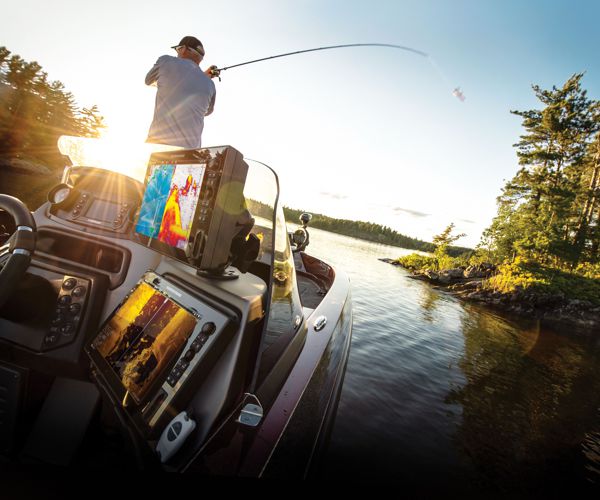
If you’re planning on mounting one of these devices on an open, small vessel, then its water-resistance level will be important. Before you buy, make sure you always check the IPX or JIS rating. These are basically the same, however, each one will determine a specific model’s water resistance level. If the device has at least a four rating this means that it will be safe from splashing water, however, it doesn’t have the level of protection that would prevent serious damage if it fell off the boat. A seven rating means that the device can be safely submerged up to ten feet for half an hour. An eight rating means that the fish finder can handle being submerged for an extended period of time. Remember, this rating will be what determines where and how you can use your fish finder.
Fixed or Portable
Do you want a device that you can permanently mount in your vessel or do you want one that you can take with you, wherever you go? A portable model will come in handy if you don’t own a boat or you and your fishing buddies take turns when it comes to boat usage. A portable unit will also come in handy for fishing retreats, or if you often rent fishing boats. These portable devices can be used in a variety of situations and their compact design makes transporting and storing them a cinch, especially if they come with a carrying case.
Fixed models are perfect for boat owners since they can be mounted precisely where you want them, with their wires neatly hidden under the bow and floorboards. The included transducer can also be attached to the hull, trolling motor, or stern, for improved security.
Before You Get Started
For most anglers, using a fish finder is simple enough. Many models these days now feature an intuitive design that makes them easy to use, even for beginners. But in some cases, it can be difficult to remember what the symbols on a display stand for or how to adjust certain settings in order to increase or decrease the sensitivity. If you don’t know how to read a hummingbird fish finder, or you’re having trouble setting up your new Lowrance fish finder, make sure you read the user manual, cover to cover, before you take your new device out on the water for the first time. Most manufacturers will use the same symbols on their displays that indicate hazards, rocks, fish, or obstacles.
If you’re new to angling and not sure where to begin, be sure to check out my guide on how to reel in a fish, where you’ll find some great tips that will teach you how to bring in your catch just like the pros.
Why You Should Upgrade
If you’ve used the same old fish finder for years, now is the time to finally upgrade to a modern device and one that comes complete with a large color display, new fish finding technology, and other extra features that are designed to improve your angling experience the next time you’re out on the water. Older models are great for providing anglers with a rough estimation of where fish might be located, but these older devices aren’t able to provide precise readings or insights including boat speed and water temperature. It’s also very common for older models to confuse fish for other types of debris such as rocks or wood. As you probably already know, modern devices are equipped with the latest in sonar technology, allowing you to view a more detailed image of the objects and structures underneath and on the sides of the boat. You’ll be surprised to learn how much fish-finding technology has changed in just a matter of a year or two. So, if you’re still using a an older device, be sure to check out my reviews of the latest models to hit the market. You’ll be blow away by all the new features, the improved accuracy, and how affordable many of the latest models now are compared to the high prices you could expect just a year or two ago.
Final Thoughts
As you can see, the best fish finder is more than just a fish locator. It will allow you to plot your route, save important information such as structures to avoid, locations that will tell you exactly where the fish are biting, and what routes are the fastest and safest. Basically, modern devices will tell you so much more than just roughly how many fish are in your general area. I hope my guide and my in-depth reviews of the top-selling models of fish finders on the market has helped you to narrow down your choices to find a device that will work for you, your angling style, and your budget.

Recent Comments